Artificial Intelligence and Robotics
The Artificial Intelligence and Robotics (AIR) program is the most advanced course offered by Adelaide Robotics and Computer Science Academy.
It is designed for high school students who have already completed our Robotics with Blocks and Robotics with Python courses and are ready to move beyond introductory tools into the technologies, concepts, and methodologies used in modern universities and industry.
AIR does not attempt to replace tertiary education.
Its purpose is to prepare students for it.
By the time students encounter these subjects at university, they will no longer feel abstract, intimidating, or unfamiliar. Instead, they will feel recognisable, structured, and meaningful.
This is a deliberate shift. A mature one.
A University-Level Program for High School Students
AIR introduces university-level robotics and artificial intelligence to high school students who are ready for the challenge, taught carefully, incrementally, and with context.
The tools, frameworks, and ideas used in this program are not simplified simulations. They are the same ones used in real-world research, development, and engineering environments.
To our knowledge, no other program in Adelaide offers this level of depth to high school students in a structured, long-term curriculum.
More importantly, no formal program worldwide has previously taught high school students the Robot Operating System (ROS) in a sustained, curriculum-based setting.
This is not a claim made for effect. It is a fact supported by the historical context of robotics education.
It is also not the first time ARCSA has taken this step.
In 2021, we became one of the first academies to teach Computer Vision to high school students, when many considered it too advanced.
AIR continues that same philosophy.
The Robotics Pillar: Advanced Robotics with ROS 2
A central component of AIR is advanced robotics using ROS 2 (Robot Operating System 2), the industry-standard middleware used in modern robotics research and development.
Students begin with the foundations required to work confidently in this environment, including:
- Linux for robotics
- Python and C++ for robotics
- Modern C++ concepts
- ROS 2 fundamentals
From there, they progress into intermediate and advanced topics such as:
- Robot navigation and localisation
- Behaviour Trees
- Robot perception and sensor fusion
- URDF robot modelling
- ROS 2 control frameworks
- Robot kinematics, dynamics, and control
- Path planning and motion
- Simulation using Gazebo and MuJoCo
This curriculum mirrors the structure of undergraduate robotics programs, adapted carefully to suit motivated high school students without diluting its substance.
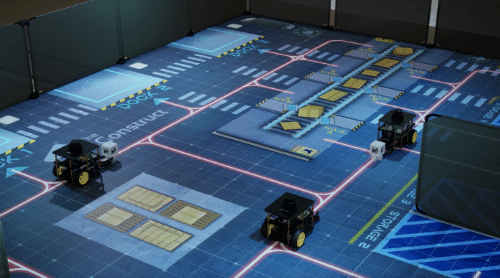
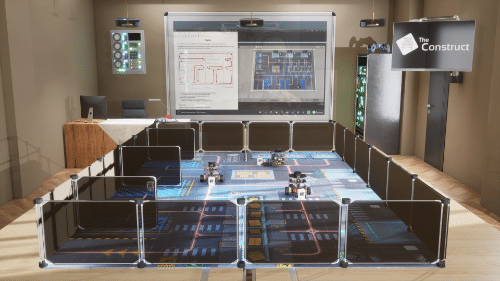
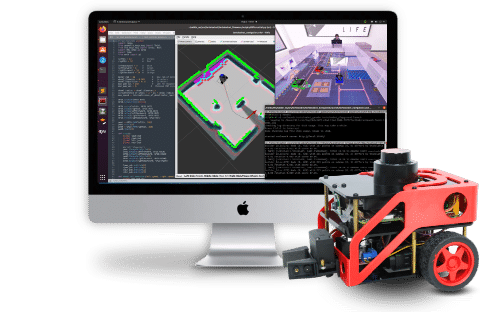
Students study advanced robotics using ROS 2 within our dedicated BotBox Robotics Lab, a professional learning environment designed to mirror how robotics is taught at university and used in industry.
Learn more about the BotBox Robotics Lab and how robotics is taught using ROS 2.
The BotBox Robotics Lab
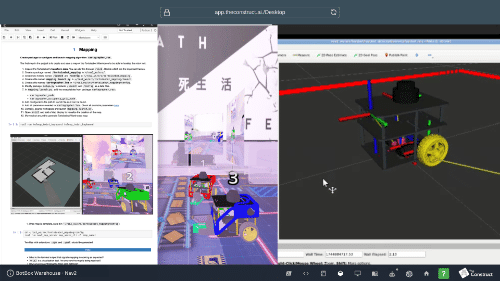
To support this level of robotics education, AIR uses the BotBox Warehouse Lab, developed by The Construct Robotics Institute.
BotBox is a professional-grade robotics learning environment that combines simulation, real robotic systems, and cloud-based development tools. It allows students to:
- Work with autonomous mobile robots
- Program navigation, perception, and manipulation systems
- Test and debug robotics software in realistic environments
- Develop skills directly transferable to university and industry contexts
Rather than focusing solely on hardware assembly, students develop programming, systems thinking, and problem-solving skills, which are core to modern robotics.
Certificates and International Partnership
AIR students work within the learning ecosystem provided by The Construct Robotics Institute, an internationally recognised robotics education organisation.
As part of this partnership, students may earn official certificates for selected modules, providing early exposure to internationally recognised credentials and learning platforms used by universities and professionals worldwide.
Further details about ROS 2, BotBox, and our partnership with The Construct will be available on dedicated pages.
The Artificial Intelligence Pillar: Learning AI by Building It
AIR treats artificial intelligence not as a black box, but as something that can be understood, implemented, and questioned.
Rather than relying solely on prebuilt tools, students learn how AI systems are constructed from the ground up.
The Go-Playing AI Project
One of AIR’s flagship projects is developing an AI that plays the game of Go.
Go is not chosen by accident. It played a central role in one of the most significant milestones in the history of artificial intelligence: AlphaGo.
Through this project, students learn:
- Machine learning fundamentals
- Tree search and Monte Carlo Tree Search
- Neural networks and deep learning
- Reinforcement learning and self-play
- Policy networks, value networks, and actor–critic methods
Students gradually build a Go-playing AI that evolves from simple decision-making to sophisticated learning through experience. This project serves as a unifying framework that makes abstract AI concepts tangible and intellectually coherent.
Large Language Models (LLM): From Foundations to Modern Architectures
Later in the program, students move into natural language processing and large language models (LLMs).
The focus here is not on using existing tools, but on understanding how they work.
Topics include:
- Natural Language Processing fundamentals
- Bag of Words and Word2Vec
- Recurrent Neural Networks and LSTMs
- Attention mechanisms before GPT
- Transformers
- Training and fine-tuning language models
- Reinforcement Learning with Human Feedback (RLHF)
Students build simplified language models themselves, gaining insight into the ideas that underpin modern AI systems.
Artificial intelligence in AIR is taught through a structured software curriculum that covers machine learning, computer vision, reinforcement learning, and language models.
Explore the Software Curriculum and how it complements robotics within AIR.
A Program That Evolves Over Time
AIR is designed as a long-term, evolving program.
Robotics and artificial intelligence alternate across terms, allowing students to return to each domain with a deeper understanding each time.
As technologies evolve, new hardware and software projects will be introduced, including advanced robotics applications, smart city systems, AI-enabled drones, and future AI research projects.
AIR is not static. It grows alongside the field itself.
Entry Requirements
AIR is an advanced program.
Students must have completed Robotics with Blocks and Robotics with Python at ARCSA.
New students may join the AIR program by passing an entry assessment that demonstrates a solid understanding of Python.
This ensures all students are prepared for the course’s pace and depth.
Looking Ahead: Future Hardware and Software Projects
AIR is designed as a program that grows with its students.
As cohorts progress through Robotics and Artificial Intelligence in alternating Terms, they are gradually introduced to more complex, open-ended projects that reflect real-world applications of AI and robotics. These projects evolve over time and may change as technologies advance, but the guiding principle remains the same: learning by building systems that matter.
Future Hardware-Focused Projects
On the hardware side, students will work on advanced, applied robotics and intelligent systems, including:
- AI Drone Programming, using machine learning and deep learning techniques for:
- Autonomous navigation
- Obstacle avoidance
- QR-code and colour-based guidance
- Voice-controlled interaction
- Reinforcement learning in simulated and real environments
- Smart City Projects, combining Python and microcontrollers to design systems such as:
- Intelligent traffic lights
- Smart parking and car-tracking systems
- Traffic flow analysis
- Anomaly and suspicious vehicle detection
These projects emphasise autonomy, perception, decision-making, and the interaction between software and the physical world.
Future Software-Focused Projects
On the software side, students continue developing advanced AI systems, particularly in computer vision, machine learning, and applied AI, through projects such as:
- AI-powered safety and security systems
- Intelligent cameras for traffic, workplaces, schools, and retail environments
- Automated assessment and monitoring systems
- Object detection, tracking, and classification systems
- Augmented reality and virtual try-on applications
- Generative AI systems for text, images, and media
Some projects rely on pre-trained models to focus on system design and integration, while others require students to train, fine-tune, and evaluate their own models, deepening their understanding of how AI systems are built and improved.
A Program That Stays Relevant
The exact mix of projects will evolve as technology evolves.
What remains constant is the structure: students alternate between hardware and software, between robotics and artificial intelligence, each time returning with stronger foundations, greater confidence, and a more sophisticated understanding of the field.
AIR is not designed to rush students toward a single outcome.
It is designed to prepare them for whatever direction they choose next.
AIR alternates between advanced robotics and artificial intelligence across terms.
Parents can explore both strands in more detail:
How can the AIR program inspire your child's future?
The AIR program can inspire your child's future by offering new activities outside of school that foster deep thinking and engagement with ideas that matter, preparing them for whatever direction they choose next.