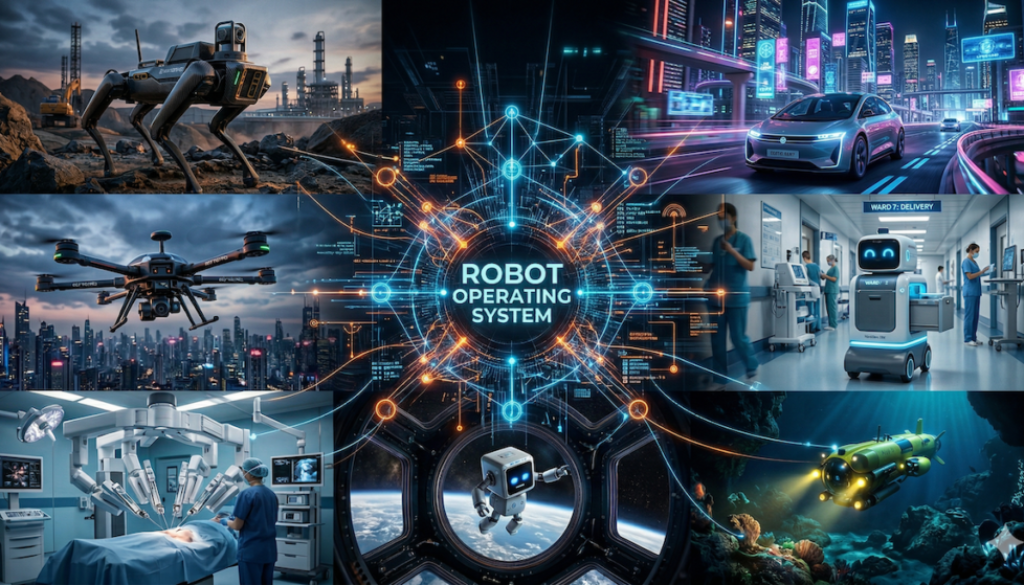
From Space To Deep Sea With One Robot Operating System
The Architecture of Autonomy: How ROS & ROS 2 Power Global Industries
The evolution of the Robot Operating System (ROS) from a monolithic, academic research tool into a decentralised, production-grade middleware has catalysed a global revolution in autonomous systems. The transition from ROS 1 to ROS 2 marks a fundamental architectural shift, replacing the centralised ROS Master with the Data Distribution Service (DDS) standard. This transition has unlocked real-time determinism, robust Quality of Service (QoS) policies, advanced node lifecycle management, and hardware-level security through SROS2. Consequently, ROS 2 has transcended laboratory environments to become the underlying nervous system for safety-critical and highly complex robotic applications across diverse operational domains.
The structural analysis of modern robotics indicates a definitive shift toward software-defined hardware. Across diverse environments—from the vacuum of space to the abyssal depths of the ocean—the reliance on standardised, open-source communication protocols is accelerating development, reducing deployment risks, and facilitating human-machine teaming. This comprehensive technical analysis examines the deployment, architectural adaptations, and commercial impact of ROS and ROS 2 across six distinct sectors: space exploration, defence, healthcare, autonomous vehicles, underwater marine environments, and aerial drones. By analysing the hardware platforms, software stacks, and key industry leaders driving this technological convergence, the ensuing data delineates how a unified open-source framework is redefining the boundaries of physical automation.
1. Space Robotics: Operating Beyond the Kármán Line
The extraterrestrial environment presents unparalleled engineering challenges, including extreme temperature fluctuations, high-radiation environments, microgravity, and severe communication latency. Historically, spaceflight software relied on bespoke, proprietary architectures. However, the requirement for rapid iteration, complex simulation, and sophisticated autonomous behaviour has driven the adoption of ROS and ROS 2 in orbital and lunar applications.
The Emergence of Space ROS
To bridge the gap between terrestrial open-source innovation and the stringent safety requirements of spaceflight, a coalition featuring NASA, Blue Origin, and Open Robotics initiated the development of Space ROS. Formulated by engineers such as Will Chambers and Amalaye Oyake from Blue Origin, alongside Michael Jeronimo from Open Robotics and Kim Hambuchen from NASA Johnson Space Center, Space ROS is a hardened variant of ROS 2. It is explicitly designed to meet aerospace mission and safety assurance standards, such as NASA’s NPR 7150.2 Software Engineering Requirements and DO-178C.
Space ROS introduces enhanced memory safety, static analysis tooling, and deterministic performance, ensuring that ROS 2 applications can be reused across different missions with minimal modification. This framework supports a broad taxonomy of space systems, including autonomous spacecraft, lunar rovers, dexterous manipulators, and multi-robot systems, significantly compressing the build-test-release cycle and reducing life-cycle costs. The architecture relies heavily on integration with the Core Flight System (cFS), allowing non-critical, computationally heavy algorithms to run within Space ROS while interfacing securely with legacy flight software. Furthermore, initiatives like the ROSLight gateway, developed in partnership with the Libre Space Foundation, utilise micro-ROS to link the Lunar Communication and Navigation Services (LCNS) with extremely resource-constrained microcontrollers, managing signal delays via Delay Tolerant Networks (DTN).
NASA’s Extraterrestrial ROS Deployments
NASA’s utilisation of ROS began on the International Space Station (ISS) with the Robonaut 2 (R2) humanoid robot, a project that heavily leveraged Gazebo simulation models of both the robot and the ISS environment. This was followed by Robonaut 5 (Valkyrie), which utilised ROS natively during the DARPA Robotics Challenge.
Currently, the Astrobee Robotic System—a trio of free-flying, cube-shaped robots named Bumble, Honey, and Queen—operates continuously aboard the ISS. Managed by NASA Ames Research Center and supported by engineers such as Lorenzo Flückiger, Kathryn Browne, Brian Coltin, and Jonathan Barlow, the Astrobee Robot Software (ARS) utilises ROS as its message-passing middleware. Astrobees are propelled by electric fans and equipped with a suite of cameras and sensors, allowing them to autonomously execute hours-long flight plans. Video feeds and photographic documentation from the ISS routinely show these robots utilising ROS-based vision localisation to navigate the US Orbital Segment, conduct acoustic monitoring (such as the SoundSee mission to detect equipment anomalies), and serve as platforms for guest science experiments like the Zero Robotics program.
Looking toward the lunar surface, NASA’s Volatiles Investigating Polar Exploration Rover (VIPER), managed by Daniel Andrews, incorporates ROS 2 directly into its ground-based control loop. VIPER is designed to navigate the rugged terrain of the Moon’s South Pole to locate water ice, utilizing open-source ROS 2 components to handle the complex kinematics and perception tasks required for lunar navigation, effectively making it one of the highest-profile extraterrestrial deployments of the middleware.
The Australian Space Ecosystem and the Roo-ver Mission
Australia has rapidly emerged as a powerhouse in space robotics, heavily anchored by the Lot Fourteen innovation district in Adelaide, South Australia. Lot Fourteen houses the Australian Space Agency (headed by Enrico Palermo), the Australian Space Discovery Centre, and the SmartSat Cooperative Research Centre (CRC) under CEO Prof. Andy Koronios.
Within this ecosystem, Saber Astronautics, led by CEO Dr. Jason Held, operates the Responsive Space Operations Centre (RSOC). Saber utilises a ROS-compatible, 3D web-based mission control interface known as PIGI (Predictive Interactive Ground-station Interface). The RSOC provides command, control, and space domain awareness for a multitude of commercial satellites, integrating machine learning for telemetry diagnostics and space traffic management, supporting operations for the US Space Force and allied networks.
Other prominent entities at Lot Fourteen include Inovor Technologies (led by Dr. Matthew Tetlow), which manufactures sovereign satellite buses like the Kanyini satellite and is developing a sovereign Low Earth Orbit (LEO) satellite for Optus. Fleet Space Technologies (co-founded by Flavia Tata Nardini) leverages satellite-enabled IoT to provide 3D subsurface mineral exploration insights, while Myriota (led by Ben Cade and Dr. David Haley) deploys massive IoT constellations.
Furthermore, the Australian Space Agency, through its Trailblazer program, has commissioned the ELO2 consortium to build Australia’s first lunar rover, officially named “Roo-ver”. Scheduled for a 2030 launch aboard an Intuitive Machines lander on the CT-4 mission, Roo-ver will collect lunar regolith for NASA’s in-situ resource utilisation experiments. Led by Consortium Director Ben Sorensen, the rover’s development involves extensive digital twin simulations. Academic partners are explicitly implementing ROS 2 nodes for power modelling, kinematics, and autonomous navigation, which are actively tested at the University of Adelaide’s Extraterrestrial Environmental Simulation (Exterres) Analogue Facility.
| ROS middleware for vision-based localisation, intra-vehicular autonomous flight, and acoustic mapping | Robot / System | ROS / ROS 2 Application Focus | Location / Deployment |
| NASA Ames | Astrobee (Bumble, Honey, Queen) | Telemetry, 3D mission visualisation, and command ingestion via web-based APIs | International Space Station |
| NASA / Blue Origin | Space ROS | Hardened ROS 2 framework for DO-178C compliance, deterministic node execution, and cFS integration | Orbit / Lunar Surface |
| NASA | VIPER Rover | ROS 2 for ground-based control loops and autonomous lunar navigation | Lunar South Pole |
| Saber Astronautics | PIGI / RSOC | Telemetry, 3D mission visualization, and command ingestion via web-based APIs | Lot Fourteen, Adelaide, AUS |
| ELO2 Consortium | Roo-ver | ROS 2 simulation for power modelling, digital twinning, and lunar regolith collection algorithms | Lunar South Pole (2030) |
2. Defence and Military Autonomous Systems
The integration of autonomous systems into defence architectures represents a paradigm shift toward “precise mass”—the deployment of scalable, uncrewed platforms to keep human operators out of contested, high-threat environments. Military doctrine increasingly views robotics as a force multiplier. ROS and ROS 2 have become foundational to this shift, evolving through initiatives like the U.S. Army Ground Vehicle Systems Center’s (GVSC) Robotic Technology Kernel (RTK). Led by figures such as Bernard Theisen, the RTK is based on ROS-M (Robot Operating System – Military) and provides a modular, government-owned autonomous software library utilised across programs like the Robotic Combat Vehicle (RCV) and autonomous leader-follower convoys.
Quadrupedal Unmanned Ground Vehicles (Q-UGVs)
Ghost Robotics, founded by Avik De and Gavin Kenneally, and currently integrating with LIG Nex1, develops the Vision 60, a highly durable, all-weather Quadrupedal Unmanned Ground Vehicle (Q-UGV). The Vision 60 utilises an open-architecture software stack that supports ROS integrations for complex perception, balancing, and manipulation tasks. The platform is engineered to operate in GPS-denied environments, utilising real-time 3D LiDAR-based SLAM (Simultaneous Localisation and Mapping).
The Vision 60 accommodates highly specialised payloads, including top-mounted 6-DOF manipulator arms, CBRN (Chemical, Biological, Radiological, and Nuclear) detection hubs, and low-latency thermal optics. Video documentation from Holloman Air Force Base and Tyndall AFB showcases the robot performing 24/7 autonomous perimeter patrols across rugged terrains.
Furthermore, the Australian Army’s Robotic and Autonomous Systems Implementation & Coordination Office (RICO), under the guidance of leaders like Lt Col Adam Hepworth and Lt Col Alex Palmer, has aggressively experimented with the Vision 60 in Sovereign Autonomy Teaming Kill Web (S-ATKW) demonstrations. In a groundbreaking technological convergence, Australian soldiers successfully utilised a brain-computer interface—combining a HoloLens augmented reality headset with a visual cortex biosensor—to issue waypoint navigation commands to a Vision 60 solely via decoded brainwaves, bypassing traditional control consoles entirely.
Tracked Combat and Logistics Systems
Estonia-based Milrem Robotics (led by CEO Kuldar Väärsi) has established the THeMIS (Tracked Hybrid Modular Infantry System) as the de facto standard for multi-role unmanned ground vehicles across European and NATO allied forces. The THeMIS platform utilises the Milrem Intelligent Functions Integration Kit (MIFIK), a sophisticated autonomy stack that enables waypoint navigation, obstacle avoidance, and follow-the-leader behaviours.
The platform’s highly modular nature allows for the integration of diverse payloads. Video demonstrations and field deployments show the THeMIS Combat variant equipped with the Rheinmetall ROSY smoke screen launcher, the FN Herstal deFNder Remote Weapon Station, and the EOS R400 system. During the Hedgehog 2025 NATO exercises, THeMIS units autonomously navigated dense forests and rugged terrain to execute casualty evacuation (CASEVAC) and frontline troop resupply under simulated combat conditions. Patrick Shepherd, Chief Sales Officer at Milrem, noted that THeMIS systems have actively supported combat efforts in Ukraine, creating a dynamic feedback loop that continuously refines the autonomous algorithms in actual combat scenarios.
Next-Generation Asymmetric Warfare and Swarm Intelligence
Anduril Industries represents the vanguard of software-defined defence technology. Founded by defence-tech veterans, Anduril’s core technology is Lattice OS, an AI-enabled software platform that synthesises data from distributed sensors and autonomous vehicles to create a unified, real-time battlefield network.
Anduril’s portfolio includes the Ghost-X autonomous aerial vehicle, a tandem-rotor drone recently selected by the U.S. Army for the Replicator initiative. The Replicator initiative, driven by Deputy Defence Secretary Kathleen Hicks, aims to mass-produce “all-domain attritable autonomous systems” to counter near-peer adversaries. The Ghost-X provides expeditionary reconnaissance in GPS-denied environments and features modular mission payloads up to 25 lbs.
In the maritime domain, Anduril Australia (led by Senior Vice President Shane Arnott) is partnered with the Royal Australian Navy and the Defence Science and Technology Group (DSTG, led by Prof. Tanya Monro) to manufacture the Ghost Shark Extra-Large Autonomous Undersea Vehicle (XL-AUV). Supported by a $20.1 million Early Works Contract, the Ghost Shark is designed for persistent, long-range intelligence, surveillance, and strike operations, utilizing ROS-compatible frameworks for autonomous subsea navigation where RF and GPS signals cannot penetrate.
| Defence Contractor | Autonomous Platform | Primary Mission Profile | Autonomy & Software Application |
| Ghost Robotics | Vision 60 Q-UGV | Perimeter security, CBRN detection, EOD, rugged terrain reconnaissance | 3D LiDAR SLAM, manipulator arm inverse kinematics, brain-computer interface mapping |
| Milrem Robotics | THeMIS | Combat support, CASEVAC, route clearance, mobile air defence | MIFIK autonomy kit, waypoint navigation, automated obstacle avoidance, ROSY integration |
| Anduril Industries | Ghost-X / Ghost Shark | Logistics, leader-follower convoys, and mine clearance | Lattice OS integration, GPS-denied visual navigation, swarm coordination |
| U.S. Army GVSC | Various UGVs | Logistics, leader-follower convoys, mine clearance | RTK (Robotic Technology Kernel) based on ROS-M for modular autonomy |
3. Healthcare: Clinical Precision and Hospital Logistics
The healthcare sector presents a highly unstructured, human-centric environment where robotics must operate with absolute safety, reliability, and social compliance. The transition to ROS 2 has been particularly transformative for medical robotics. Unlike ROS 1, ROS 2 features lifecycle node management—ensuring software components transition predictably through unconfigured, inactive, and active states—and relies on DDS middleware to eliminate single points of failure. These characteristics are essential for regulatory compliance under frameworks such as FDA medical device guidelines, ISO 13482 for personal care robots, and IEC 62443 for cybersecurity.
Autonomous Hospital Logistics
A significant portion of a clinical worker’s shift—often up to 30%—is consumed by non-value-added transport tasks, such as fetching supplies or delivering lab samples. To alleviate this burden amid global nursing shortages, companies have developed autonomous mobile robots (AMRs) tailored for hospital corridors.
Aethon, a pioneer in this space led by CEO Aldo Zini and VP of Marketing Tony Melanson, developed the TUG robot, which executes over 5 million deliveries annually. TUGs autonomously transport meals, linens, laboratory specimens, and secure pharmacy medications. Utilizing a ROS 2 Nav2 stack coupled with LiDAR and fleet management algorithms, the TUG dynamically avoids obstacles and integrates via Wi-Fi with building management systems to autonomously call elevators and open secure doors. Video footage from institutions like UCSF, St. Elizabeth Healthcare, and The Royal Melbourne Hospital visually demonstrates TUGs navigating crowded hallways and crossing busy intersections seamlessly, monitored via Aethon’s Cloud Command Center.
Similarly, Diligent Robotics, founded by social robotics experts Andrea Thomaz and Vivian Chu, created Moxi—a mobile manipulation robot designed specifically to assist nurses. Moxi features a compliant robotic arm, a pillar-like base with locked drawers, and an expressive LED face that flashes “heart eyes” to foster social acceptance among patients and staff. Completing over 1.25 million deliveries across 25 U.S. hospital networks (including Cedars-Sinai, Northwestern Medicine, and Rochester General Hospital), Moxi is powered by NVIDIA Jetson edge compute and trained in simulation using NVIDIA Isaac Sim and Isaac Lab. Recently acquired by Serve Robotics, Moxi relies heavily on ROS for its mapping, mobile manipulation, and human-guided learning capabilities. Diligent’s engineering team, including figures like robotic software engineer Lauren Hutson and Clinical Informatics Manager Matthew Terbeek, rely on ROS 2 data pipelines to execute real-time debugging and spatial mapping.
Surgical Robotics and Image-Guided Interventions
In the operating theatre, robotics enables minimally invasive procedures with sub-millimetre precision, drastically reducing recovery times. CMR Surgical has developed the Versius system, an advanced robotic surgical platform recently granted FDA 510(k) clearance for cholecystectomy procedures. Led by CEO Massimiliano Colella and President Chris O’Hara, the Versius system has completed over 45,000 cases worldwide. Versius distinguishes itself through a modular, portable design; individual robotic arms are mounted on separate bedside units, allowing them to be moved flexibly between operating rooms without requiring dedicated, oversized surgical suites. The platform features an open console and a robust digital ecosystem (Versius Connect and Versius Team) that logs procedural telemetry data and synchronises surgical video for post-operative analysis.
For academic and clinical research, the da Vinci Research Kit (dVRK) has democratised surgical robotics. Formed through a collaboration between Intuitive Surgical, Johns Hopkins University (JHU), and Worcester Polytechnic Institute (WPI), the dVRK repurposes decommissioned first-generation da Vinci robots. Led by researchers like Peter Kazanzides, Russell Taylor, and Anton Deguet, the community utilises open-source controllers and a full ROS/ROS 2 software stack to interface directly with the master tool manipulators (MTMs) and patient side manipulators (PSMs).
Furthermore, the ROS for Medical Robotics (ROS-MED) project and SlicerROS2 provide vital architectural bridges between robot kinematics (via ROS 2) and medical imaging software (3D Slicer). This integration enables complex image-guided interventions, allowing surgeons to overlay pre-operative CT or MRI scans onto real-time robotic trajectories using ROS 2’s tf2 transform libraries, paving the way for applications like automated pedicle screw placement and percutaneous needle interventions.
| Robotics Company / Project | Robot System | Application Area | ROS 2 / Technical Architecture Highlights |
| Aethon | TUG | Hospital logistics, pharmacy, lab specimens | Nav2 stack, 2D/3D LiDAR, building system API integration, Cloud Command Center |
| Diligent Robotics | Moxi | Nursing assistance, mobile manipulation | NVIDIA Jetson, Isaac Sim, socially compliant manipulation, lifecycle node management |
| CMR Surgical | Versius | Minimally invasive soft-tissue surgery | Modular bedside units, digital telemetry logging, force feedback, vLimeLite fluorescence |
| Intuitive / JHU / WPI | dVRK | Academic surgical research | Full ROS 1/ROS 2 bridge for kinematics, open-source controllers for MTM/PSM |
| ROS-MED | SlicerROS2 | Image-guided interventions | Bridges 3D Slicer imaging with ROS 2 rclcpp for real-time tracking via OpenIGTLink |
4. Autonomous Vehicles: The Road to Level 5 Autonomy
The automotive industry’s pursuit of fully autonomous driving demands software capable of processing massive volumes of sensor data from cameras, LiDAR, and radar in hard real-time. Operating systems must recognise obstacles, calculate trajectories, and control vehicle dynamics with zero tolerance for system failure.
The Autoware Ecosystem
The open-source community’s answer to this challenge is Autoware, initially developed in 2015 by Shinpei Kato at Nagoya University and now managed by the Autoware Foundation. Autoware provides a complete autonomy stack—including localisation, object detection, route planning, and control—built natively on ROS and ROS 2.
As the limitations of ROS 1 became apparent in automotive contexts—specifically its lack of real-time guarantees, reliance on a centralised master node, and non-deterministic memory allocation (e.g., dynamically resizing standard vectors during execution)—the industry recognised the need for a robust successor. Autoware.Auto (now transitioning to Autoware Core/Universe) was subsequently developed from the ground up on ROS 2, leveraging the DDS protocol to ensure deterministic, distributed communication across multiple in-vehicle electronic control units (ECUs).
The Autoware Foundation’s board, including figures like Yang Zhang, Christian John, and Daisuke Tanaka, steers the project to enable commercial deployment across robotaxis, delivery vehicles, and Mobility-as-a-Service (MaaS) applications. The framework provides extensive simulation support, including a highly refined bridge connecting the CARLA simulator directly with Autoware Core/Universe for system-level safety assessment.
Safety Certification and Commercialisation
While Autoware provides the algorithmic foundation, deploying these systems on public roads requires adherence to strict functional safety standards, notably ISO 26262 ASIL-D. Apex.AI, co-founded by Jan Becker and Dejan Pangercic, addresses this by providing Apex.Grace (formerly Apex.OS), a heavily optimized, safety-certified fork of ROS 2.
Apex.AI’s engineering approach effectively strips out the dynamic memory allocations and blocking calls (such as fprintf or fwrite) inherent in standard C++ implementations of ROS 2. By moving memory allocation strictly to the initialisation phase and implementing strict timeouts on all operations, Apex.Grace guarantees hard real-time execution. In collaboration with Green Hills Software, Apex.AI integrated its framework with the INTEGRITY RTOS (Real-Time Operating System), providing a secure separation kernel that protects critical functions from cyber threats.
By collaborating closely with Tier IV—a deep-tech startup integrating Autoware into commercial vehicles—Apex.AI bridges the gap between open-source innovation and automotive-grade reliability. Furthermore, modern software-defined vehicles (SDVs) require interoperability between modern Service-Oriented Architectures (SOA) and legacy automotive frameworks. Solutions like the ASIRA (Autonomous Driving System with Integrated ROS2 and Adaptive AUTOSAR) architecture utilise ROS 2 SOME/IP bridges to allow seamless data exchange between ROS 2 perception nodes and AUTOSAR Classic/Adaptive control systems, ensuring that cutting-edge AI can securely interface with traditional brake-by-wire and steer-by-wire hardware.
| Organization / Platform | Technology | Primary Contribution to AV Industry | ROS Integration Level |
| Autoware Foundation | Autoware Core / Universe | Complete open-source end-to-end autonomous driving stack | Turn-key commercialisation of AVs (robotaxis, delivery) |
| Apex.AI | Apex.Grace (Apex.OS) | ISO 26262 ASIL-D safety-certified middleware | A hardened, real-time fork of ROS 2 for commercial automotive deployment |
| Tier IV | AV Integration | Turn-key commercialization of AVs (robotaxis, delivery) | Primary contributors to Autoware; integrators of ROS 2 perception libraries |
| Baidu | Apollo | Industrial-grade AV platform heavily used in China | Based on a heavily modified, proprietary fork of ROS |
5. Underwater and Marine Robotics: Navigating the Abyss
The subsea environment is arguably the most hostile domain for robotics. High hydrostatic pressure, the rapid attenuation of radio frequencies (rendering GPS and standard Wi-Fi useless), and the low bandwidth of acoustic modems require underwater vehicles to possess high degrees of localised autonomy. ROS 2 serves as the ideal framework for integrating complex hydrodynamics, sonar processing, and thruster allocation.
Accessible Ocean Exploration
Traditionally, marine robotics was restricted to well-funded military or oil and gas entities. Blue Robotics disrupted this paradigm by manufacturing affordable, high-performance marine components, culminating in the BlueROV2. The BlueROV2 features a six-to-eight thruster vectored configuration, providing full six degrees of freedom.
The vehicle operates using ArduSub (a branch of ArduPilot) running on a Pixhawk or Navigator flight controller, paired with a Raspberry Pi companion computer. The onboard software, BlueOS (developed heavily by engineers like Patrick José Pereira), facilitates extensive integration with ROS 2 and MAVLink. This architecture allows researchers to overlay complex autonomous behaviours—such as visual pipeline tracking via YOLO object detection or ORB-SLAM3—on top of the ROV’s basic stability controls. Video evidence from various university teams and startups (such as Mission Robotics’ 500m dive in Lake Tahoe) showcases the BlueROV2 utilising ROS for advanced acoustic mapping and autonomous navigation.
Building on this ethos of accessibility, the Monterey Bay Aquarium Research Institute (MBARI) developed the MOLA AUV (multimodality, observing, low-cost, agile autonomous underwater vehicle). Led by Principal Engineer Giancarlo Troni and ocean observatory engineer Jared Figurski, the MOLA AUV utilises a modified Boxfish submersible core. Powered by an NVIDIA Jetson Xavier running ROS 2, the MOLA AUV fuses data from 4K forward-looking cameras, stereo vision, and forward-looking sonar to map the seafloor and construct 3D photomosaics using AI-based algorithms, overcoming the traditional limitations of acoustic-only subsea mapping.
Enterprise and Resident Subsea Systems
In the commercial offshore energy sector, the focus has shifted toward “resident” systems—robots that remain submerged on the seafloor for months, deploying from subsea docking stations to recharge and download data without requiring expensive topside support vessels.
Oceaneering’s Freedom AUV represents the pinnacle of this hybrid AUV/ROV technology. Operating at depths of up to 6,000 meters, Freedom utilizes a proprietary software architecture called COMPASS, which executes feature-based navigation. Driven by leaders like Peter Buchanan and Casey Glenn, the vehicle achieved Technology Readiness Level (TRL) 6 by analysing sonar and computer vision data onboard. Freedom can autonomously identify subsea anomalies, track pipelines at altitudes of 3-5 meters, and perform touch-free cathodic protection measurements in a single pass, triggering automated sub-missions upon recognising free-spans or burials. Video footage from Oceaneering’s Living Lab in Tau, Norway, demonstrates the vehicle executing autonomous horizontal docking and precise payload placement.
Similarly, Saab Seaeye produces advanced hybrid systems like the Sabertooth and the eWROV. The eWROV is an all-electric work-class ROV that matches the performance of a 250-horsepower hydraulic vehicle but with a vastly reduced environmental footprint due to its zero-oil design. Procured by Ocean Infinity for their Armada fleet of uncrewed vessels, these industrial systems frequently utilise ROS architectures internally to fuse sensor arrays and manage complex manipulator inverse kinematics during high-torque valve interventions.
| Company / Institution | Robot Platform | System Type | Key Features and ROS Implementations |
| Blue Robotics | BlueROV2 | Micro-ROV (Observation) | BlueOS companion software, MAVLink to ROS 2 bridging, highly accessible community ecosystem |
| MBARI | MOLA AUV | Portable AUV | ROS 2 on NVIDIA Jetson Xavier, AI sonar mapping, 4K visual stereoscopy, Boxfish core |
| Oceaneering | Freedom AUV | Resident Hybrid AUV/ROV | COMPASS software, autonomous subsea docking, single-pass pipeline inspection, 6000m depth |
| Saab Seaeye | eWROV / Sabertooth | Electric Work-Class ROV | Heavy manipulation, long-endurance hovering, zero-oil environmental design |
6. Aerial Robotics and Drones: The Software-Defined Sky
Unmanned Aerial Vehicles (UAVs) face severe Size, Weight, and Power (SWaP) constraints. High-frequency flight stabilisation must occur within milliseconds on a real-time microcontroller, while computationally heavy tasks like object detection and path planning require robust microprocessors (e.g., Raspberry Pi or NVIDIA Jetson). ROS 2 solves this hardware bifurcation flawlessly through the micro XRCE-DDS (eXtremely Resource Constrained Environments) protocol.
The Flight Stack Bridge and Simulation
Modern aerial autonomy relies on robust open-source flight controllers—primarily PX4 and ArduPilot—handling the low-level motor mixing and attitude control. The XRCE-DDS bridge seamlessly exposes internal PX4 uORB (Micro Object Request Broker) messages directly as ROS 2 topics and types. This allows developers to write high-level ROS 2 nodes (e.g., an OpenCV script detecting an ArUco marker or YOLOv8 tracking a vehicle) that publish trajectory setpoints directly to the flight controller at high frequencies.
This architecture supports massive acceleration through simulation. Frameworks like the open-source aerial-autonomy-stack allow engineers to run full Software-In-The-Loop (SITL) and Hardware-In-The-Loop (HITL) testing using Gazebo, executing flight logic 20 times faster than real-time before ever flashing code to physical hardware. For multi-robot coordination, frameworks like Aerostack2 (developed by researchers including Martin Fernandez-Cortizas) provide native ROS 2 swarming capabilities, allowing independent drones to share spatial awareness and execute distributed missions without centralized control.
Commercial and Defence Aerial Platforms
In the commercial and defence hardware space, the focus has pivoted sharply toward secure, domestically manufactured hardware, driven by legislative mandates like the Blue UAS certification.
Teal Drones (a subsidiary of Red Cat Holdings, founded by George Matus and led by CEO Jeff Thompson) manufactures the Golden Eagle and the Teal 2. Designed for short-range tactical reconnaissance, the Teal 2 features a modular architecture integrated with the FLIR Hadron 640R payload, delivering high-resolution thermal imaging for nighttime operations. Teal platforms are increasingly utilising computer vision for GPS-denied navigation, partnering with companies like Immervision for low-light stereoscopic vision and Palantir to integrate Visual Navigation (VNav) software directly onto the edge compute. Similarly, Skydio leads the enterprise market with the X10, utilising advanced AI and computer vision for autonomous obstacle avoidance in infrastructure inspection and Drone as First Responder (DFR) applications.
Auterion has capitalised on the demand for standardised software by developing AuterionOS, a commercial, enterprise-grade distribution of the open-source PX4 autopilot. Led by PX4 creator Lorenz Meier, alongside CTO Markus Achtelik and COO Rob Rainhart, Auterion provides the Skynode—an all-in-one avionics module that tightly integrates flight control with a ROS 2-enabled companion computer. This software-defined approach allows hardware manufacturers to bypass building software from scratch. Auterion’s technology recently powered the Artemis deep strike drone, a long-range system capable of navigating 1,000 miles in highly contested, GPS-jammed environments utilizing visual terminal guidance. The system has seen successful operational flight tests and deployments in Ukraine, proving the viability of bridging ROS-based autonomy with military-grade avionics.
| Drone Manufacturer / Software | Platform / Technology | Target Market | Key Capabilities & ROS 2 Role |
| Dronecode / PX4 | PX4 Autopilot / XRCE-DDS | Open-source foundation | Bridges low-level RTOS flight control directly to high-level ROS 2 nodes |
| Auterion | Skynode / AuterionOS | Defense and Enterprise | Turn-key avionics module; native ROS 2 integration for AI payload processing; Artemis drone |
| Teal Drones | Teal 2 / Golden Eagle | Military / Short-Range ISR | Blue UAS certified, FLIR thermal imaging, GPS-denied visual navigation (VNav) |
| Skydio | Skydio X10 | Enterprise / Public Safety | AI-driven autonomous obstacle avoidance, Drone as First Responder (DFR) |
| Aerostack2 | Swarm Framework | Research & Development | Native ROS 2 framework for hardware-agnostic multi-UAV coordination |
Conclusion
The extensive proliferation of the Robot Operating System across the aerospace, defence, medical, automotive, marine, and aerial sectors underscores a profound maturation in robotics engineering. The data reveals a definitive shift from isolated, proprietary software silos to collaborative, modular architectures.
The transition to ROS 2 has been the primary catalyst for this industrial convergence. By adopting the Data Distribution Service (DDS) standard, ROS 2 mitigated the critical vulnerabilities of its predecessor—namely, the centralised point of failure and lack of real-time determinism. Today, whether it is a Diligent Robotics Moxi navigating hospital corridors, a Ghost Robotics Vision 60 conducting perimeter security, or an Apex.AI-powered autonomous vehicle relying on ASIL-D certified middleware for highway navigation, the underlying digital infrastructure remains remarkably consistent.
Ultimately, this standardisation bridges the “simulation-to-reality” gap. Frameworks like Gazebo and SlicerROS2 enable rapid iteration, accelerating innovation by allowing computer vision code developed for a BlueROV2 subsea vehicle to seamlessly influence the navigational logic of an autonomous lunar rover. As autonomous systems continue to scale in complexity and deployment mass, open-source, safety-certifiable frameworks like ROS 2 and Space ROS will remain the indispensable foundation of global physical automation.
To master the skills required to engineer these state-of-the-art systems, ARCSA’s comprehensive Robotics and AI courses provide the ultimate stepping stone. By enrolling in ARCSA’s programs, students gain hands-on experience with the exact ROS and ROS 2 architectures currently deployed by industry leaders like NASA, Aethon, and Auterion, bridging the gap between theoretical knowledge and real-world deployment in the rapidly expanding automation sector.