How Not to Lose Your Job to AI: The Skills That Matter Now
The skills AI makes more valuable and how to learn them
Artificial intelligence will automate parts of almost every job. That is not the end of human work. It is a shift in which skills become essential. The practical goal of this guide is to help you or your child pick skills that rise in value as AI improves, and give you concrete ways to learn them.
This is a how‑to article; you will find checklists, example projects, and a 30‑day plan you can start today.
Fast summary
• As AI takes over repeatable, well‑specified tasks, it raises the value of skills it cannot easily do, and of skills needed to deploy AI safely and productively.
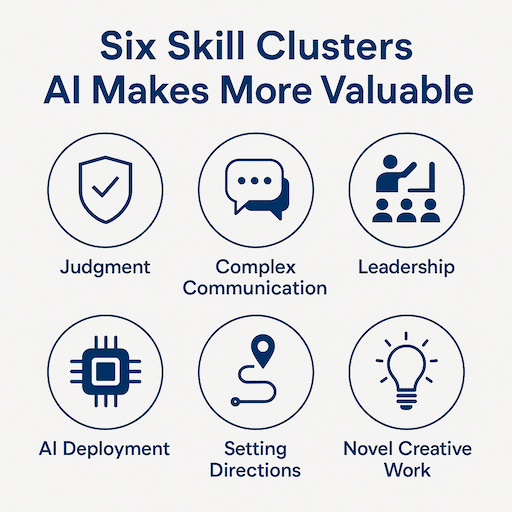
• The six skill clusters most likely to gain value are:
1. Using AI to solve real problems, 2) Personal effectiveness (learning fast, social skills, productivity), 3) Leadership (management, strategy, research taste), 4) Communication and taste, 5) Getting things done in government, 6) Complex physical skills.
• If you only do one thing that is learn to deploy AI on real problems in your domain.
• Entry‑level, routine white‑collar tasks are under pressure. Aim to leapfrog them by building projects, taking small leadership responsibilities early, and showing you can ship outcomes with AI.
What changes with AI, in one picture
• More leverage: one person, equipped with AI, can do the work of a small team. The bottleneck shifts to deciding what to do, coordinating, and verifying quality.
• Complement, don’t compete. The durable edge is at the interface: humans deciding the goals, scoping messy problems, working with other humans, and running systems in the real world.
• Portfolios beat CV lines. Output matters. Finished projects that solve problems are more convincing than generic credentials.
The six skill clusters that get more valuable:
1) Using AI to solve real problems
What it is: turning a fuzzy, real‑world need into a working solution using AI tools. This includes problem framing, data wrangling, constraint handling, integrations, testing, and monitoring for failure modes.
Why it rises: as AI gets better, people who can steer it against real constraints become force multipliers. The messy parts that AI cannot handle end‑to‑end become the bottleneck.
How to learn it:
• Pick a real user and ship something in four weeks. Examples below.
• Treat models as components. Learn prompt patterns, function calling, retrieval, evaluation, safety checks, and cost control.
• Build a habit of measurement. Define success metrics, run A/B tests, keep a changelog.
Starter projects:
• Build a study coach that plans and checks a student’s weekly schedule, then measures outcomes.
• Create a “first‑draft assistant” for grant applications that assembles a draft from a structured brief and past wins.
• Make a help‑desk triage bot that tags, drafts replies, and hands off correctly, with human approval in the loop.
2) Personal effectiveness
What it is: a bundle of compounders: rapid learning, focus, systems for getting things done, and pro‑social habits that make teams better.
Why it rises: these skills multiply everything else and remain useful even as tasks change.
How to learn it:
• Use an AI tutor daily to compress learning cycles. Keep a spaced‑repetition deck for new concepts.
• Run your week with a simple cadence: plan on Friday, execute Monday–Thursday, review on Sunday.
• Practice feedback. Ask for one concrete suggestion after every major piece of work.
Practice drills:
• Ten‑minute task decomposition: write steps before you start.
• Rubber‑duck your plan to a teammate or an AI, capture their pushback, and update the plan.
3) Leadership skills
What it is: setting direction, coordinating people and resources, and making good decisions under uncertainty.
Why it rises: AI increases individual throughput. The scarcest skill becomes deciding what to build and aligning people to do it.
How to learn it:
• Start small: lead a two‑person project. Own scope, timeline, and post‑mortem.
• Shadow someone good. Observe 1:1s, hiring screens, and prioritisation meetings.
• Practice strategy: write a one‑page plan that states the problem, constraints, options, chosen path, and risks.
Signals you are improving. Fewer dropped balls, clearer priorities, faster decisions, calmer execution.
4) Communication and taste
What it is: explaining clearly to different audiences, and exercising judgment about what is good. Taste is discerning signal from noise and choosing quality.
Why it rises: content is abundant. Trust is scarce. People follow people, not feeds.
How to learn it:
• Publish consistently. Newsletter, devlog, short videos, or teaching notes. Track what resonates.
• Build a real relationship with a specific audience. Ask for replies. Answer them.
• Curate. Keep a public list of the best resources in your niche and revise it quarterly.
5) Getting things done in government
What it is: navigating public institutions to pass or implement policies, procure technology, and make systems work.
Why it rises: people expect humans in the loop on public decisions. As automation scales, competent operators who can frame, sequence, and shepherd change remain critical.
How to learn it:
• Learn the entry paths: legislative staffer, fellowships, internships, and policy analyst roles.
• Train the skills: coalition‑building, stakeholder mapping, brief writing, and public interest framing.
• Pair with domain expertise: cybersecurity, infrastructure, education, or health.
6) Complex physical skills
What it is: precise work in unpredictable environments with real‑world constraints. Think semiconductor technicians, data‑centre electricians, surgical teams, field robotics engineers, skilled trades.
Why it rises: robotics adoption lags software. Where work is dynamic, risky, or high‑precision, humans remain the safest, fastest option for longer.
How to learn it:
• Choose a growing niche that aligns with national priorities. Apprentice, certify, and build a reputation for reliability.
• Pair physical skill with digital skill. Instrument your work. Keep logs. Use AI for planning and quality assurance.
Skills with a more uncertain future
These are not “do not touch” and require a different approach.
• Routine knowledge work. Drafting, summarising, and standard analysis. Keep it, but move up the value chain.
• Coding and applied STEM. Still powerful, especially coupled with domain insight, but the entry level is getting automated. Focus on systems thinking, architecture, tool evaluation, and shipping products.
• Visual creation. AI lifts everyone’s floor. Your edge is concept, taste, and storytelling.
• Predictable manual jobs. Vulnerable to automation where environments are structured.
How to stay safe if you start here.
• Combine with one of the six clusters above.
• Build a portfolio of shipped outcomes. Show where you used AI to go further than a baseline.
How to learn these skills: a practical roadmap
A. The 30‑day plan
Week 1
• Pick a user and a problem. Write a one‑page brief with the goal, constraints, measures of success, and risks.
• Audit your AI toolbox. Choose one chat model, one code assistant, one vector database or notes system, and one evaluation method.
Week 2
• Decompose the problem. Identify the parts to automate, the parts for human judgment, and the interfaces between them.
• Build a first version. Keep a logbook of prompts, failures, and fixes.
Week 3
• Put a human in the loop. Define acceptance criteria. Add basic monitoring and cost tracking.
• Ship to two real users. Ask for blunt feedback. Fix the top three defects.
Week 4
• Measure impact against the brief. Write a short post‑mortem with what you would change next time.
• Publish a demo and a readme. Add the project to your portfolio.
B. Weekly habits that compound
• One project at a time, shipped every four weeks.
• One hour of deep reading on your domain, three times a week.
• One conversation with someone better than you, every week. Ask what you are doing wrong.
• One page of notes on what surprised you. Revise your model of the world.
C. Tools you will use
• A reliable notebook of reusable patterns: prompts, evaluation scripts, failure cases, and checklists.
• A personal knowledge base. Keep source links and your own summaries.
• A simple metrics dashboard. Track time saved, error rates, and satisfaction.
Example learning paths
Teenagers and early university
• Project spine. Every term, ship one project that helps a real person. Ideas:
• A study planner that schedules, monitors, and adapts based on results.
• A robotics challenge where a robot must navigate a changing course and explain its plan.
• A local‑civics tool that drafts a letter to a councillor from a structured template and checks tone and accuracy.
• Skill blocks. Alternate between fundamentals and deployment:
• Python, data handling, version control, testing.
• Prompting patterns, retrieval and function calling, evaluation, and safety.
• Communication: write a build log; present a demo.
Career changers and professionals
• Pick an edge. Pair your domain knowledge with AI deployment. Finance, health, construction, education, customer operations.
• Start inside your job. Automate one painful workflow, and document the impact.
• Go for small leadership moments. Run a pilot, coordinate two people, own the debrief.
Skilled trades and physical work
• Add sensors and simple data capture to your process. Use AI to plan, estimate, and check quality.
• Document repeatable procedures with photos or short video; build your own playbook.
Portfolios that get attention
A strong AI‑era portfolio shows four things.
1. You can choose problems that matter.
2. You can ship working solutions.
3. You can measure outcomes and improve.
4. You can work with people and earn trust.
How to present it.
• A landing page with three projects. Each has a 90‑second demo, a short write‑up, metrics, a repo link, and a paragraph on what you would do next.
• A change log that shows how you learn.
• One page that explains your approach to safety, testing, and privacy.
Hiring signals to cultivate
• You volunteer to own outcomes and report progress without prompting.
• You think in experiments. You propose the next test, not just the next task.
• You can explain trade‑offs in plain language to a non‑technical person.
• You leave systems and documentation better than you found them.
Risks and how to handle them
• Over‑automation. Keep a human check where errors are costly. Write down failure modes you have seen.
• Privacy and security. Avoid sending sensitive data to external services unless contracts and controls are in place. Redact, sandbox, and log.
• Model drift. Re‑evaluate outputs regularly. Keep a small, representative test set.
• Fragility. Prefer simpler systems. Fewer moving parts, clearer interfaces, more tests.
For parents and educators
• Encourage projects that help real people. A sibling, a grandparent, a neighbour, a club.
• Reward working demos and clear explanations over flashy visuals.
• Teach the habit of measuring. Ask students to define success before they start.
• Model healthy AI use: attribution, critical thinking, and privacy.
What ARCSA adds
Adelaide Robotics and Computer Science Academy focuses on skills that compound in an AI‑rich world: problem framing, coding, robotics, data, communication, and building for real users. Students learn by shipping projects, presenting to peers, and reflecting on results. We use proven robotics curricula and complement them with modern AI deployment patterns, so students learn both fundamentals and how to apply them.
Check out our Robotics Course with Python, Computer Science Course and Scholarship Program to see how we’re embedding these principles in our teaching. For enrolments, visit our Enrolmy page.
If you are a parent, professional, or student and want help selecting a path, talk to us. We can suggest a project that fits your goals and constraints.
A final word
You are not competing with AI, but partnering with it to solve problems people care about. Focus on skills AI enhances, not skills it replaces. Build things, measure, learn, then teach someone else what you learned.
Appendix: Checklists you can copy
Four‑step project checklist
1. Problem brief with success metrics.
2. First version in seven days.
3. Ship to two users and collect feedback.
4. Measure, fix three things, and publish.
Deployment checklist
• Guardrails: privacy, safety, and testing in place.
• Evaluation: a small test set with pass/fail thresholds.
• Logging: prompt, input, output, and cost logged.
• Ownership: who is on call when it breaks.
Weekly cadence
• Friday plan. Monday commit. Tuesday build. Wednesday test. Thursday ship. Sunday review.
Taste training
• Save five examples a week of “good” work in your field. Write one sentence on why each is good. Revisit monthly.
Leadership reps
• Own one meeting. Own one risk. Own one 1‑page decision memo.
Free downloads: